
Part of my role as Research and Innovation Coordinator for UAL Online involves grappling with the pedagogical implications of generative AI. As well as engaging with conventional forms of research into GenAI, I have been using practice-led research methods to help think through the intricacies and affordances of these emerging technologies. Building on ideas and research by colleagues in UAL’s colleges and institutes, in the Learning and Teaching Directorate, and by researchers beyond UAL, several key concepts have surfaced that I have used as starting points for the creation of a series of LLM-powered chatbots.
The UAL AI staff training course created by Chris Rowell, Digital Learning Producer Community in the Learning and Teaching Directorate, alerted me to Socratic questioning, which got me interested in the idea of a chatbot as a question-poser, rather than the more typical answer-giver. Through lengthy discussions with Dave White, Dean of Academic Strategy Online, I became aware of various arguments being presented by Wesley Goatley, Programme Director IDVC at LCC, including the dangers of AI mimicking a human, and the environmental and ethical benefits of local AI. I learned via Wesley that system prompts can change default chatbot responses, which informed the approach I took with my own chatbot creations. For example, the system prompts that sit under the bonnet of many of my chatbot experiments instruct the LLM to respond only with questions, and to not mimic a human (conveniently aligning with point 04 of the recently published UAL AI Principles, ‘Think of AI as a machine, not a person’).
Criteria Bot – structured questioning for students
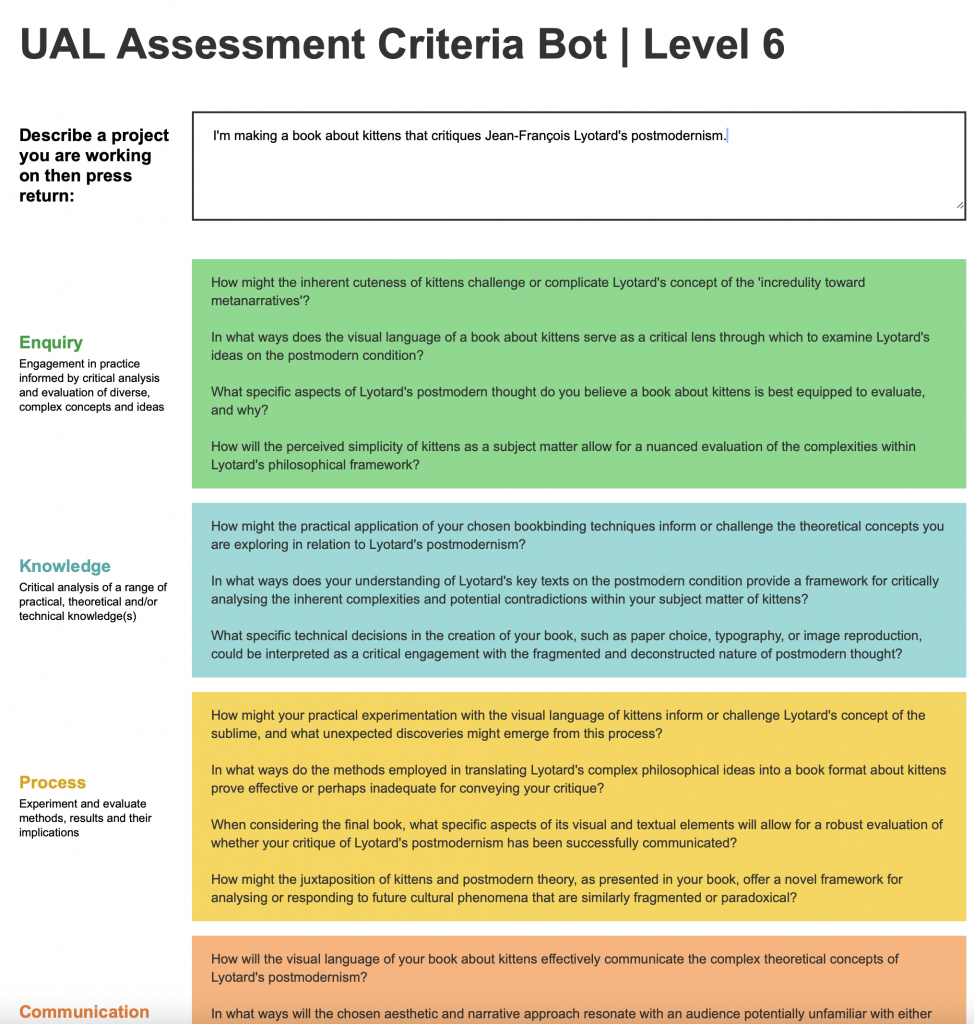
My most developed AI experiment, Criteria Bot, provides students with a tool to help formulate questions about their works-in-progress, using each category of the UAL assessment criteria to help structure the bot’s responses. As well as helping students reflect on their project work in a structured manner, the tool also helps familiarise students with the assessment criteria that will ultimately be used to grade their final outcomes, well in advance of any deadlines.
I was invited by Darryl Clifton, Programme Director of Illustration at Camberwell College of Arts, to show the Criteria Bot to students studying on BA (Hons) Illustration and to join Darryl’s lecture about GenAI. In the discussion that followed the lecture, students voiced their very strong feelings about AI. They were particularly sensitive to threats to their employment prospects but also expressed anger about the theft of artworks for models training, the environmental impact of AI, and the dubious morals of the companies driving AI growth. Experiencing the strength of feeling about GenAI from these students reminded me of the importance of engaging regularly and meaningfully with the people whose lives are going to be affected in the long-term by technological advances. I’m endeavouring to keep such concerns at the forefront of my mind whilst tinkering with LLMs, and this is informing the technical approaches I am taking.
In the case of the Criteria Bot, this has led me to develop three versions of the tool, each addressing different needs and concerns. The first version is a web-based bot powered by Google’s Gemini-2.5-flash-lite, with inference provided by Google’s cloud services. This version is the most powerful and does a reasonably good job of providing a set of criteria-centric questions for students when they input a description of their project.
The second is a web-based version powered by the swiss-ai/apertus-8b-instruct model. Although it is less powerful than Gemini, Apertus is fully open and was trained with transparent and ethically sourced data on a carbon-neutral supercomputer in the Swiss Alps. Inference for this iteration of Criteria Bot is served by the Swiss-based Public AI Inference Utility, a project that seeks to reframe AI inference as public infrastructure, like roads or the water supply. This version could offer an alternative for students who might have ethical and/or environmental objections to Google.
The third version is a MacOS app that runs a local model, Qwen2.5-3B-Instruct-4bit, which (if deployed) would provide an option for students who don’t want their data to go into the cloud and through a data centre, or who want to accurately measure the environmental impact of their use of the tool.
These attempts to think and work through the ethical and environmental aspects of GenAI align with point 3 of the UAL AI Principles, ‘Use responsibly: there will be climate, social and reputational impacts’. (For anyone planning to play with any of my experimental chatbots, it is also worth noting point 6 of the AI Principles, ‘Only input what you have a right to use and share’ – avoid inputting any sensitive data or words you don’t have the right to paste.)
Kate Greenslade, Lecturer in Experimental Imaging and Illustration on the BA (Hons) Fashion Imaging and Illustration course at LCF, kindly let me test the Gemini and Apertus versions of Criteria Bot with her Level 6 students, who had been exploring AI in depth as part of Kate’s coursework. Feedback from the students was broadly positive, with several students including evaluations of their use of the Criteria Bot in their final submissions for assessment. In their written reflections, students reported that using Criteria Bot encouraged them to take a more deliberate and reflective approach and pushed them to reflect more critically. There is growing evidence that generalised chat-bots like ChatGPT and Claude, which are typically over-eager to provide an abundance of answers, dampen down critical thinking. However, Socratic questioning machines like Criteria Bot can help activate thinking, as usefully demonstrated by one of Kate’s students, who wrote highly personal but critically adept responses to each of the questions posed by the Criteria Bot. This is a small sample size and a more thorough evaluation of student use of the tool will be necessary before any firm conclusions can be drawn, but early indications suggest that Criteria Bot, or similar narrowly-focused tools, could benefit a wide range of UAL students.
Maybe Bot – the devil’s advocate
The excellent book, ‘The Power of Maybes’ by Betti Marenko, Reader in Design and Techo-digital Futures at CSM, provided inspiration for my second experiment, the Maybe Bot. The system prompt that guides this bot ensures that anything a user types in is robustly contradicted, with a set of ‘maybes’ offered to provoke alternative ways of thinking about the user’s input. This refined devil’s advocate bot, if it was officially deployed, could help develop critical thinking skills in students.
Frictionary – making things more difficult
Building on research into the importance of cognitive friction in learning, my third experiment, Frictionary, takes a user input, and instead of helping to make things easier (the default with general chatbots), generates a list of ways to make things more difficult. For example, a student stuck in a creative rut might input details of their design project and receive a list of suggestions that introduce convoluted procedures that need to be followed or it might suggest unusual technical processes that would make their project more challenging. Frictionary could be a useful tool for gently encouraging students out of their comfort zones without inducing panic.
My fourth experiment is a tool called Hexit that appropriates Edward De Bono’s 6 thinking hats framework to help users think through an idea in six very different ways. The user inputs something they are pondering, and the bot refracts it through factual, emotional, risk-averse, optimistic, innovative, and practical lenses.
My final experiment is a Venn-diagram tool called Intersector that attempts to hybridise two concepts into one. The user types an idea into one circle, another idea into the other circle, and the bot attempts to synthesise them into a combined idea in the overlapping section.
Final thoughts
All these chatbots are prototypes (expect errors) created primarily as mechanisms to help investigate different aspects of GenAI as part of a wider research programme. Whether they get developed into tools that can, or should, be deployed at scale is up for debate. I’m currently using a personal Google AI API account and a personal account with the Public AI Inference Utility to power all my web-based chat-bot experiments (see Point 7 of the AI Principles, ‘Using AI not provided by UAL incurs increased risk and costs’). This home-grown approach severely limits the capacity to safely and economically scale up the use of these tools, but I hope in the future to use a more sustainable UAL-provided inference solution or find a way to safely distribute local-running AI apps to students. I also have a half-baked idea about putting ‘kiosks’ with custom local-running AI chatbots in studios to encourage social AI use, but that needs thinking through properly. If you have any thoughts about this research, challenges you want to make about my assumptions, or suggestions for where we might head next, please get in touch.
All Ian’s AI chatbot experiments can be found here:
Author Details
Name: Ian Truelove
Contact: i.truelove@arts.ac.uk
Leave a Reply